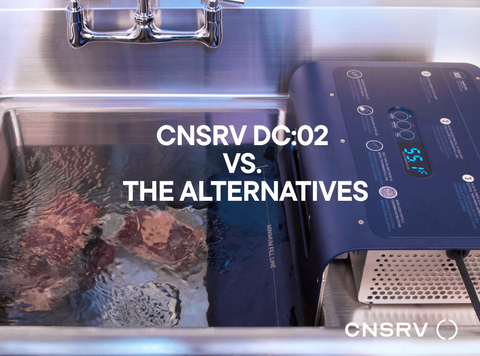
CNSRV DC:02 vs. the Alternatives: An Honest Thawing Equipment Comparison
Commercial kitchens thaw frozen product four ways: a running faucet, the walk-in, a forced-air thawing cabinet, or a controlled water system like the CNSRV DC:02. The faucet is free upfront but uses hundreds of gallons per cycle and is hardest to keep at or below 70°F; the walk-in is safest but takes 12 to 24 or more hours and lowers yield; a cabinet is hands-off but costs capital and floor space; the DC:02 thaws up to 2× faster than a faucet with 98% less water and drops into an existing prep sink with zero install.
You have decided the running faucet has to go, and now you have one nagging question: what actually thaws food fastest, safest, and cheapest in a real commercial kitchen? Every vendor swears it is their option. Here is the honest version, including where each one genuinely wins, because none of them wins everywhere.
Key takeaways
- A commercial faucet runs at 4 to 8 gallons per minute, so a multi-hour thaw sends hundreds of gallons down the drain and a busy kitchen can burn over a million gallons a year.
- FDA Food Code Section 3-501.13 requires thawing water to stay at or below 70°F, but summer tap water in much of the country runs 75 to 85°F before it touches the food.
- Walk-in thawing keeps food at or below 41°F but takes 12 to 24 or more hours and thaws in stages, which lowers yield.
- A thawing cabinet is hands-off but costs capital, takes floor space, draws power continuously, and is slower than circulating water for most proteins.
- The CNSRV DC:02 circulates water at roughly 130 gallons per minute versus about 7 from a faucet, cuts thaw time by up to half, uses 98% less water, auto-shuts at 66°F, and is NSF51 certified.
How do the four thawing options compare at a glance?
The DC:02 is the fastest and lowest-water option with no install; the faucet is free upfront but water-hungry and hard to keep compliant; the walk-in is safest but slowest; the cabinet is hands-off but costs capital and floor space.
| Speed | Water use | Upfront cost | Floor space & install | Compliance & documentation | |
|---|---|---|---|---|---|
| Running faucet | Moderate; slows to a crawl if turned down | Very high — hundreds of gallons per cycle | $0 | None, but ties up a prep sink for hours | Hard to hold ≤70°F; no records; often breaks time limits |
| Walk-in / refrigerator | Slowest — often 12–24+ hours | None | None beyond your existing walk-in | Consumes shelving you need for storage | Safest (stays ≤41°F), but no active process record |
| Thawing cabinet | Slow to moderate; hands-off | None to low | High — capital equipment | Dedicated floor footprint plus continuous power | Controlled temperature; automatic hold; hands-off |
| CNSRV DC:02 | Fastest — up to 2× a faucet | 98% less than a faucet | One drop-in unit | None — drops into your existing prep sink, zero install | Auto temp cutoff, NSF51, logged repeatable cycles |
Why does the running faucet cost so much if it is free?
The faucet has no upfront cost, but the recurring water bill makes it the most expensive way to thaw food once you tally what you are actually spending. That $0 is the only argument for it, and it is the wrong argument; the water bill is the entire reason kitchens come looking for an alternative. A standard commercial kitchen faucet runs at 4 to 8 gallons per minute, so a single multi-hour thaw dumps hundreds of gallons down the drain. Multiply that across multiple cycles a day, every day, and a busy kitchen burns over a million gallons a year, and pays the water-and-sewer bill for every gallon of it. For the full math, see how much water commercial kitchens waste thawing food.
It is also the hardest method to keep compliant. FDA Food Code Section 3-501.13 requires the water to stay at or below 70°F, but summer tap water in much of the country runs 75–85°F before it even touches the food. There is no documentation, someone has to babysit it, and it ties up a sink you need for everything else.
Is walk-in thawing the safest option, and what does it cost you?
Walk-in thawing is the safest method because food stays at or below 41°F the entire time, but it is the slowest and quietly lowers yield. Dense protein can take 12 to 24 hours or more, which means planning a full day ahead and surrendering walk-in shelving you need for storage.
The quality argument cuts the other way from how it is usually told. Refrigeration thaws in stages, with fat, water, and muscle defrosting at different rates as the cold radiates through the product, which leaves you with uneven product and water loss as the cell structure releases moisture. Controlled cold-water circulation defrosts the fat and water phases at the same time, producing more even results and higher product yield. For most proteins, refrigeration is not the yield winner. It is the safe-but-slow option that quietly costs you product.
It works for predictable, scheduled prep. It falls apart the moment you need product thawed today that you did not pull yesterday, which, in most kitchens, is most days.
What are the trade-offs of a forced-air thawing cabinet?
A thawing cabinet is hands-off, but it is a significant capital purchase, takes dedicated floor space, draws power continuously, and is slower than circulating water for most proteins. Forced-air cabinets use controlled temperature, humidity, and airflow to thaw product without supervision, and many switch to a holding mode once food is up to temperature. For a kitchen with the floor space and the budget, the hands-off workflow is appealing.
A cabinet also does nothing for the prep-sink workflow most kitchens actually run. It is a separate appliance you route product to, not a fix for the station you already have.
How does the CNSRV DC:02 thaw faster without the floor space?
Instead of still water or moving air, the CNSRV DC:02 circulates water at roughly 130 gallons per minute, versus about 7 from a faucet, so every surface stays in even contact and thaw times drop by up to half. It uses 98% less water than a running faucet, and a heating element gradually raises the water temperature and auto-shuts at 66°F, a built-in cushion below the 70°F limit, so the station stays compliant without anyone watching a thermometer.
Its structural advantage over a cabinet is what it does not require: it drops into any standard prep sink with zero installation and no plumbing changes, so it takes no new floor space and no capital build-out. It is NSF51 certified, meets FDA Section 3-501.13 and California Retail Food Code Section 114020, and logs consistent, repeatable cycles that are easy to hand an inspector. The simultaneous-phase defrost also produces higher yield than refrigeration and more even results across the product. For thaw-time planning by protein, the Defrosting Time Guide lays out the cycles.
Health inspector note
The difference inspectors care about is documentation. A faucet and a walk-in leave you with nothing to show; the DC:02 produces a consistent, repeatable cycle you can point to. It was independently reviewed by Dr. Eric Schulze, PhD, a former FDA food-safety regulator, who confirmed it meets FDA Food Code Section 3-501.13 and California Retail Food Code Section 114020. See the full health and safety breakdown.
Real kitchen example
The Butchery Quality Meats evaluated the DC:02 and, by the owner's account, knew within a week it was essential, with faster defrosting and a significant drop in water use. Nobu Malibu reported saving over $2,000 on water bills in the first month after switching from the faucet.
Which thawing method should a commercial kitchen buy?
For a working commercial kitchen with same-day prep, limited floor space, an inspector who can walk in any day, and a water bill nobody wants to keep paying, the answer is the DC:02. It is faster than the faucet, gentler on compliance than any method that depends on manual monitoring, produces higher yield and more even results than refrigeration, and asks for none of the floor space or capital a cabinet would. For building the station itself, see how to set up a thawing station in your commercial kitchen.
What is the bottom line?
The right answer is the system that solves all four problems at once, water cost, compliance, product yield, and floor space, without asking you to manage them by hand. The faucet trades a $0 upfront price for a recurring water bill and constant compliance risk. Refrigeration trades speed and yield for safety. A cabinet trades capital and floor space for hands-off convenience. The DC:02 trades nothing: it pays back monthly in water savings, holds compliance automatically, produces higher yield, and drops into the sink you already have.
Use the CNSRV savings calculator to see what your current method costs you in water every year, or book a demo to see the DC:02 next to your current setup.
Frequently asked questions
What is the fastest way to thaw frozen food in a commercial kitchen?
Controlled water circulation. The CNSRV DC:02 circulates water at roughly 130 gallons per minute versus about 7 from a faucet, cutting thaw times by up to half; the walk-in is slowest at 12 to 24 or more hours.
How much water does thawing under a running faucet use?
A commercial faucet runs at 4 to 8 gallons per minute, so a multi-hour thaw sends hundreds of gallons down the drain; a busy kitchen can use over a million gallons a year.
Is thawing in the walk-in safer than cold-water thawing?
It keeps food at or below 41°F the entire time, which is its real strength. The trade-off is 12 to 24 or more hours, lost storage shelving, and staged thawing that lowers yield compared with controlled cold-water circulation.
Are thawing cabinets worth the cost?
They are hands-off with controlled temperature, but they are a significant capital purchase, need dedicated floor space, draw power continuously, and thaw slower than circulating water for most proteins.
Does the CNSRV DC:02 meet FDA Food Code requirements?
Yes. Dr. Eric Schulze, PhD, a former FDA food-safety regulator, independently confirmed it meets FDA Food Code Section 3-501.13 and California Retail Food Code Section 114020. It auto-shuts at 66°F and is NSF51 certified.
Does the DC:02 require installation or plumbing changes?
No. It drops into any standard prep sink with zero installation and no plumbing changes, so it needs no new floor space.