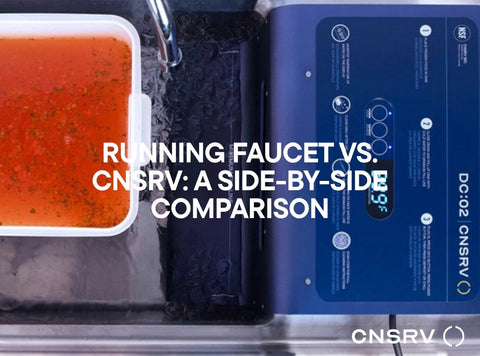
Running Faucet vs. CNSRV: A Side-by-Side Thawing Comparison for Commercial Kitchens
A case of frozen turkey sits in the prep sink. The faucet is on full and has been since the morning crew clocked in. Water hits one corner of the pile, runs across the top, and goes straight down the drain. Nearly five hours later, the outside is soft and the middle is still hard. This post puts that method next to the CNSRV DC:02 and compares them on time, water, cost, food safety and quality.
Watch the side-by-side test
In our test, turkeys under a running faucet took nearly 5 hours to thaw and used over 2,000 gallons of water. The DC:02 thawed a similar amount of chicken in under 2 hours using only 10 gallons.
The numbers at a glance
| Running faucet | CNSRV DC:02 | |
|---|---|---|
| Thaw time in our test | Nearly 5 hours | Under 2 hours |
| Water used in our test | Over 2,000 gallons | 10 gallons |
| Water and sewer cost per thaw at $0.025 per gallon | About $50 | About $0.25 |
| How the water moves | Pounds down on one spot | Circulates around every piece |
| Evenness | Soft outside, frozen center | Even from edge to center |
| Sink | Tied up for hours | Free for prep |
| Labor | Staff check, rotate and restack | Load it and walk away |
The running faucet problem
It thaws unevenly
A faucet pounds water down on a single portion of the food. The pieces under the stream thaw first. The pieces at the bottom and in the middle wait. You end up with product that is warm on the outside and frozen at the core, which is bad for food safety and bad for the plate.
It wastes water you pay for
A commercial prep faucet runs at 4 to 8 gallons per minute. Over a five hour thaw that adds up to over 2,000 gallons, and you pay for it twice: once as water and once as sewer. At $0.025 per gallon combined, one thaw costs about $50. See the yearly totals in how much water commercial kitchens waste thawing food.
It takes over your kitchen
The sink is out of use for the whole thaw. Someone has to keep checking the product and moving it around. If the thaw runs long, the menu waits on it.
Real kitchen example: A kitchen that runs one faucet thaw like our test every day spends about $50 a day on that water and sewer. That is about $18,250 a year for one sink. The same daily thaw in the DC:02 costs about $91 a year in water.
Health inspector note: FDA Food Code Section 3-501.13 allows thawing under running water only when the water is 70°F or colder and flows fast enough to flush loose particles away. Uneven thawing makes it harder to keep the outside of the food out of the temperature danger zone while the center catches up. Read Section 3-501.13 explained for the full rule.
What kitchens are switching to
The CNSRV DC:02 is a closed-loop cold-water thawing system. You fill it once, and it circulates that cold water around every piece of food for the whole cycle. The faucet stays off.
- Half the time. Moving water touches every surface, so the whole batch thaws together.
- 98% less water. The water is filled and recirculated, not run down the drain.
- Safer, more even results. No warm edges and frozen centers.
- Better quality and yield. Cold-water thawing protects texture and moisture. See why cold-water thawing produces the highest-quality food.
- Your sink back. The DC:02 does the thawing so the prep sink can do prep.
The DC:02 is NSF certified and a National Restaurant Association Kitchen Innovations Award recipient. Kitchens including Nobu, Ritz-Carlton and Dodger Stadium use it every day. In some regions, water utilities also offer rebates on top of the savings. Check the rebate guide by state.
The bottom line
The running faucet takes more than twice as long, uses about 200 times the water, and still thaws unevenly. The DC:02 thaws faster, safer and more evenly for about a quarter per cycle in water. Every day the faucet runs, you pay the difference.
Use the savings calculator to see what your kitchen spends on thawing water today, or book a demo to see the DC:02 side by side with your current method.