Why Running-Water Thawing Is Risky: The Hidden Safety, Cost, and Compliance Problems
Running-water thawing is still one of the most common methods in commercial kitchens — but it is also one of the least safe, least predictable, and most resource-intensive practices still in use today. What used to be seen as a convenience is now recognized by food-safety experts as a major liability.
This article breaks down why running faucets create hidden risk, what the FDA and California Food Code actually require, and why modern continuous-movement systems are rapidly replacing this outdated practice.
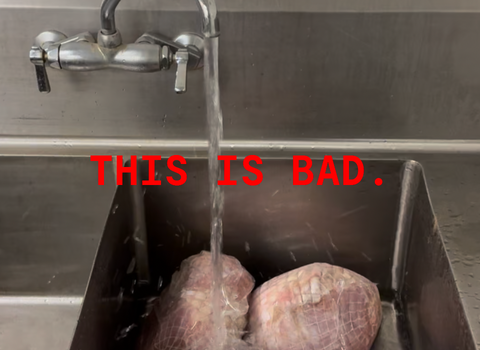
The running-faucet method in practice: continuous flow, straight to the drain.
1. Running Water Thaws Only a Small Portion of the Food
Operators assume running water “bathes” the food, but in reality:
-
Only one point of the product is being hit by water
-
The rest sits partially exposed to warm air
-
Heat transfer is inconsistent and slow
-
Warm pockets form on surfaces above the waterline
This results in:
-
Uneven thawing
-
Temperature swings
-
Higher bacterial growth risk
Compare this to full-submersion thawing, where 100% of the surface area is in equal contact with temperature-controlled water.
See also:
Cold Water vs Walk-In vs CNSRV: Full Comparison
2. Tap Water Often Exceeds the 70°F Limit Required by Code
FDA Food Code + CA Retail Food Code require:
-
Water must be ≤70°F
-
The process must finish in ≤2 hours
But in practice:
-
Many regions supply tap water at 75–85°F, especially in summer
-
Kitchen staff rarely measure water temperature
-
Thawing times for large proteins often exceed 2 hours
-
Faucet settings drift as operators step away
This means most running-water thawing quietly violates code without anyone realizing it.
For more, see:
Understanding FDA & California Thawing Requirements
3. Running Water Allows Warm Zones to Develop
Even when the water is cool enough, running-water thawing has structural temperature problems:
-
Only the splashed side thaws
-
The top of the product warms into the danger zone
-
The underside sits in stagnant water with poor movement
This temperature stratification is why health departments treat running-water thawing as high-risk unless tightly controlled.
Contrast with continuous circulation systems, which prevent warm pockets entirely.
4. Water Waste Is Extreme — And Completely Unnecessary
Commercial faucet flow rates: 6–10 gallons per minute
Running-water thawing for typical proteins: 20–60 minutes
This means:
-
45 minutes × 8 gpm = ~360 gallons per cycle
-
Large proteins like turkeys can require >3,000 gallons
-
A single kitchen can waste hundreds of thousands of gallons per year
Hotels, groceries, and high-volume restaurants pay enormous water/sewer bills because of this. Run your own numbers with the water savings calculator.
5. Labor and Operational Problems
Operators must:
-
Monitor the water temperature
-
Adjust the faucet flow
-
Ensure the product stays submerged
-
Keep the process under the 2-hour limit
But in reality:
-
Staff step away
-
Water temperature increases
-
Items float or shift position
-
Timing isn’t tracked
This creates inconsistent results and real safety risks.
6. Why Modern Systems Are Replacing Running Water
Continuous-movement thawing systems like CNSRV DC:02:
-
Maintain water <70°F
-
Fully submerge food
-
Circulate water at ~130 GPM
-
Avoid warm zones
-
Reduce water use by 98%
-
Thaw food up to 50% faster
They eliminate the guesswork and dramatically reduce compliance liability.
Explore the technology:
👉 CNSRV DC:02 Gen2 Product Page
Bottom Line
Running-water thawing is:
-
Inconsistent
-
Risky
-
Resource-intensive
-
Often out of compliance
-
Scientifically inferior to full-surface, controlled thawing
Modern operators are shifting to continuous-movement systems that improve safety, speed, uniformity, and sustainability.