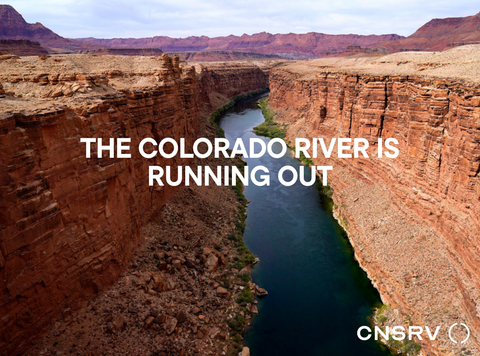
The Colorado River Is Running Out. Your Kitchen's Thawing Method Is Part of the Problem.
A commercial kitchen in Phoenix starts its morning prep. Frozen protein goes into the sink, the faucet runs, and somewhere between 500 and 1,000 gallons of water head straight down the drain before the first service of the day. Two miles away, Lake Mead sits at one of its lowest levels on record. The federal government just ordered Arizona to cut its Colorado River water use by 31%. The kitchen and the crisis are connected. This post explains how, and what operators in affected states can do about it right now.
The Colorado River crisis is not a future problem
The Colorado River's two largest reservoirs, Lake Mead and Lake Powell, serve as the primary storage and delivery infrastructure for the entire river system. Both are in serious trouble. Lake Mead appears on track to tumble to its lowest level on record, and Lake Powell could potentially fall so low by spring 2027 that it reaches minimum power pool level, meaning its dam will no longer be able to generate hydropower.
The federal government has released a new operating plan for the Colorado River requiring Arizona, California, and Nevada to take about 20% less water from the river over the next two years. The cuts break down by state:
- Arizona: 31% reduction. Phoenix is now tapping its emergency water bank for the first time in more than 35 years to keep water flowing to residents.
- Nevada: approximately 28% reduction
- California: approximately 12% reduction
Federal officials are ordering the West to live within the limits of a Colorado River system drained by decades of over-allocation, drought, and policy delay.
What this means for commercial kitchens
If your kitchen operates in California, Arizona, or Nevada, your water provider draws from a system that just got federally mandated to deliver less. That pressure does not stay at the policy level. It flows downstream to utilities, to water rates, and eventually to your monthly bill.
Water conservation in these states is no longer a sustainability choice. It is becoming an operational and financial reality.
The question for commercial kitchen operators is where the biggest savings opportunities are. And one of the largest, most overlooked answers is right at the prep sink.
Real kitchen example
A busy commercial kitchen running three to four thaw cycles a day under a running faucet can easily burn through 500,000 to one million gallons of water a year, just on defrosting. At commercial water and sewer rates in Los Angeles or Phoenix, that number translates to thousands of dollars a month in water costs, quietly running down the drain. That is not a fixed cost. It is a variable one with a direct solution.
The thawing problem in numbers
A standard commercial kitchen faucet runs at 4 to 8 gallons per minute. A single three-hour thaw cycle uses between 720 and 1,440 gallons of water. For a kitchen running multiple cycles a day across multiple locations, annual water consumption from thawing alone can exceed one million gallons per location.
In states now facing mandatory water reductions, that is not just a cost problem. It is a conservation problem that utilities, regulators, and increasingly their customers are starting to notice.
What kitchens are switching to
The CNSRV DC:02 is a closed-loop thawing and chilling system that drops into any existing prep sink with zero installation and no plumbing changes. Instead of draining hundreds of gallons per cycle, it recirculates the same water in a controlled, temperature-regulated loop.
The result: up to 98% less water than a running faucet, thaw times cut by up to half, and a fully compliant process that meets FDA Food Code Section 3-501.13 without manual monitoring.
For a kitchen in Los Angeles, Phoenix, or Las Vegas running multiple thaw cycles a day, that 98% reduction is not a small number. It is the difference between a kitchen that contributes to a stressed water system and one that actively reduces its draw.
Health inspector note
Water conservation regulations are moving fast in Colorado River-dependent states. California, Arizona, and Nevada are all under pressure to reduce municipal and commercial water use. Kitchens that proactively cut water-intensive processes now are ahead of what may become mandatory commercial conservation requirements. The DC:02 was independently reviewed by Dr. Eric Schulze, PhD, a former FDA food-safety regulator, who confirmed it meets FDA Food Code Section 3-501.13 and California Retail Food Code Section 114020.
Rebates make the switch even easier in affected regions
Water utilities in Colorado River-dependent regions are actively paying commercial kitchens to reduce water use. CNSRV has confirmed rebate partnerships with:
- Metropolitan Water District (MWD) — Southern California: $800 per unit
- Los Angeles Department of Water and Power (LADWP) — Los Angeles: up to $2,300 per unit
- Marin Water — Northern California
- Tampa Bay Water — Florida
These programs exist precisely because utilities are under pressure to reduce consumption at the commercial level. Installing the DC:02 in a qualifying region means the rebate offsets the upfront cost while the monthly water savings continue indefinitely.
What operators are seeing in practice
Mambo Seafood, a multi-location seafood restaurant group in Texas, saves an average of $800 per month per location after switching to the DC:02, 38,000 gallons of water every month per location, 450,000 gallons per year. Nobu Malibu, operating in one of California's most water-stressed markets, reported saving over $2,000 on water bills in the first month alone.
These are not projections. They are what operators in the field are reporting after making the switch.
The bottom line
The Colorado River crisis is real, it is accelerating, and it is already translating into mandatory cuts for three of the most commercially active states in the country. Commercial kitchens in California, Arizona, and Nevada face a direct stake in how much water they use, and thawing is one of the highest-volume, most solvable water problems in the back of house.
The DC:02 cuts thawing water use by up to 98% from the prep sink you already have. In a region where water is being rationed at the federal level, that is not just a financial decision. It is the right operational call.
Use the CNSRV savings calculator to see what your current thaw process costs you annually, then book a demo to see how the DC:02 fits into your kitchen.