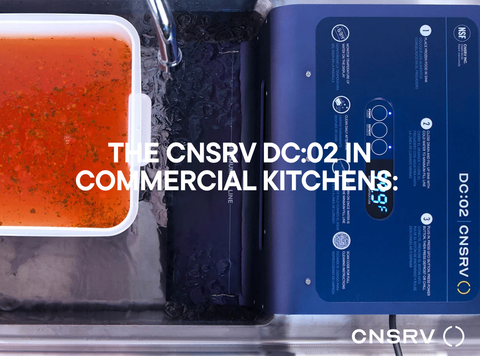
The CNSRV DC:02 in Commercial Kitchens: Real Results from Real Operations
The CNSRV DC:02 is a closed-loop commercial kitchen thawing and chilling system that drops into any standard prep sink with zero installation, uses 98% less water than a running faucet, and delivers documented FDA-compliant cycles. In practice, commercial kitchens across restaurant groups, hotels, stadiums, grocery seafood departments, and butcher operations are reporting hundreds to thousands of dollars in monthly water savings, half-the-time defrost cycles, and a compliance record that stands up to inspection. Here is what operators are actually seeing across every major commercial kitchen category.
Commercial kitchen results at a glance
| Operation type | Featured customer | Reported result |
|---|---|---|
| Restaurant group | Nobu Malibu | Over $2,000 in water bill savings in the first month |
| Multi-location restaurant chain | Mambo Seafood (TX) | $800/location/month saved; 38,000 gallons/location/month conserved |
| High-volume event kitchen | Dodger Stadium | Consistent, compliant defrost at game-day scale across multiple kitchens |
| Grocery seafood counter | Grocery chain pilot | 3-hour tuna cycle → under 90 min; 900 gal per cycle → under 20 |
| Butcher operation | The Butchery Quality Meats | DC:02 essential to the operation within the first week |
Every number in this table came from a live commercial kitchen operating the DC:02 in normal service.
The problem the DC:02 was built to solve
Running-faucet thawing is the most common defrosting method in commercial kitchens today — not because it is efficient, but because it is familiar. A standard commercial kitchen faucet flows at 4 to 8 gallons per minute. A single multi-hour thaw cycle dumps hundreds of gallons of water down the drain. Multiply across multiple cycles per day, across multiple locations, and the annual water cost climbs into the tens of thousands of dollars per operation.
Beyond the water bill, faucet thawing creates operational friction most kitchens do not track:
- Inconsistent thaw times that do not fit the prep schedule
- Labor spent monitoring the sink and manually adjusting temperature
- Compliance exposure from water temperatures that drift above the FDA's 70°F limit
- Product yield loss that shows up as a gap between what you bought and what made it to the plate
The CNSRV DC:02 was built to replace every one of those problems with one controlled, repeatable system.
How the CNSRV DC:02 works: one system, two modes
The CNSRV DC:02 is a closed-loop thawing and chilling system that drops into any standard commercial prep sink with zero installation and no plumbing changes.
Defrost mode
The DC:02 circulates water at approximately 130 gallons per minute — versus about 7 GPM from a running faucet — creating even surface contact across every product in the basin. A heating element gradually raises water temperature and auto-shuts at 66°F, a built-in cushion below the FDA's 70°F legal limit, so the station stays compliant without anyone watching a thermometer. Defrost cycles run up to half the time of a running faucet, using 98% less water.
Chill mode
The DC:02 handles both sides of the temperature workflow. In chill mode it brings hot food down to 70°F within the two-hour FDA cooling window — meeting the requirements of FDA Food Code Section 3-501.13 for thawing and Section 3-501.14 for cooling, from a single prep sink.
Certification and compliance
The DC:02 is NSF51 certified and was independently reviewed by Dr. Eric Schulze, PhD, a former FDA food-safety regulator, who confirmed it meets FDA Food Code Section 3-501.13 and California Retail Food Code Section 114020. See the full health and safety breakdown for how each standard is met.
Featured customer results across commercial kitchen types
The DC:02 is deployed across every major commercial kitchen category. Here is what operators in each segment are seeing.
Restaurant groups: Nobu Malibu
Nobu runs one of the highest-profile sushi and hospitality programs in the country. Nobu Malibu reported saving over $2,000 on water bills in the first month after installing the DC:02 — a first-cycle-forward payback story that continued month over month. For a program where product quality and compliance are both non-negotiable, the DC:02 delivered on both without changing the workflow the kitchen already ran.
Multi-location restaurant chains: Mambo Seafood
Mambo Seafood, a multi-location seafood restaurant group operating across Texas, deployed the DC:02 across its network. Per-location results:
- $800 saved per location per month in water costs
- 38,000 gallons of water conserved per location per month
- Prep-time recovery during peak service hours as staff no longer babysit the sink
For a multi-location operator, those numbers scale linearly with rollout — turning the DC:02 from an equipment purchase into a recurring monthly cost recovery across the entire network.
High-volume event kitchens: Dodger Stadium
Dodger Stadium runs one of the highest-volume kitchen operations in the country, feeding tens of thousands of guests per game across multiple kitchens simultaneously. Game-day timing does not tolerate an unpredictable four-hour faucet cycle. The DC:02 delivers predictable defrost timing across every kitchen on the property, water savings at game-day scale, and a fully compliant defrost process that survives inspection at any moment during a high-pressure prep window.
Grocery seafood counters
A grocery chain running the DC:02 in a pilot for tuna defrost reported:
- Tuna thaw cycle: 3 hours reduced to under 90 minutes
- Water use: 900 gallons per cycle reduced to under 20
- Compliance documentation consistent across every store in the pilot
For grocery chains rolling out across dozens or hundreds of locations, the DC:02's drop-in profile makes the deployment a receiving-and-setup task rather than a construction project. For the full grocery breakdown, see Why Grocery Store Chains Are Switching to Closed-Loop Thawing Systems.
Butcher operations: The Butchery Quality Meats
The Butchery is a butcher operation where product quality is the entire business. After evaluating the DC:02, the owner reported the system was essential to the operation within the first week of use — faster defrost cycles and a significant reduction in water use, with consistent yield across every cut. For a business where drip loss and uneven thaw show up directly on the counter, the yield story is as important as the water savings.
What operators consistently see across every commercial kitchen type
Across every commercial kitchen category, the DC:02 delivers the same pattern of results.
Water costs drop immediately
The closed-loop system recirculates rather than drains. Operators consistently report water and labor savings that start from the first cycle — savings that in many cases exceed the unit's cost on a monthly basis. For a multi-location operator, that math compounds across the entire network.
Thaw times become predictable
When staff know exactly how long a defrost cycle takes, they plan prep schedules around it instead of working around an unpredictable faucet. For high-volume operations — stadiums, hotels, catering, chain restaurants — predictable defrost timing is not a convenience. It is an operational requirement.
Compliance becomes automatic
The DC:02 holds temperature and circulation through the entire cycle without anyone watching a thermometer. Documentation becomes straightforward. The compliance risk that manual faucet thawing creates every shift is removed. For a full breakdown of what compliance actually requires, see FDA Food Code Section 3-501.13 Explained.
Product yield goes up
Cold-water thawing, done properly, defrosts fat and water phases simultaneously — which produces higher product yield and more even results than refrigeration's staged thaw or a faucet's uneven surface contact. On a butcher counter or a sushi menu where visible quality is the brand, that yield gain is measurable. See Why Cold-Water Thawing Produces the Highest-Quality Food for the science.
Health inspector note The DC:02 produces documented, repeatable cycles that a health inspector can review directly — the compliance record that manual thawing cannot deliver. Independently reviewed by Dr. Eric Schulze, PhD, a former FDA food-safety regulator, and NSF51 certified. See the health and safety breakdown for how each FDA and California requirement is met.
How the DC:02 fits into existing commercial kitchen infrastructure
The DC:02 is not a replacement for your existing kitchen infrastructure. It fits into the prep sink you already have, with no new plumbing, no new floor space, and no capital build-out. That deployment profile is one of the reasons multi-location and chain operators can roll it out across dozens or hundreds of locations without a per-store construction project.
One system. One prep sink. Two modes — thaw and chill. A water and compliance problem that pays for itself monthly.
For a full setup guide, see How to Set Up a Thawing Station in Your Commercial Kitchen. For a direct comparison against thawing cabinets and walk-in options, see CNSRV DC:02 vs. the Alternatives: An Honest Thawing Equipment Comparison.
Frequently asked questions about the CNSRV DC:02
What does the CNSRV DC:02 actually do?
The DC:02 is a closed-loop commercial kitchen thawing and chilling system that drops into a standard prep sink with zero installation. It circulates water at 130 GPM at a controlled temperature (auto-shutoff at 66°F) to defrost frozen food, and reverses in chill mode to bring hot food down to 70°F within the FDA two-hour cooling window.
How much can a commercial kitchen actually save with the DC:02?
Reported customer results include Nobu Malibu at over $2,000/month in first-month water bills, Mambo Seafood at $800 per location per month, and a grocery seafood pilot reducing tuna defrost from 900 gallons per cycle to under 20. Actual savings depend on volume, local water rates, and current defrost method. Use the CNSRV savings calculator for your operation's specific numbers.
Does the DC:02 require plumbing changes or new floor space?
No. The DC:02 drops into any standard commercial prep sink with zero installation, no plumbing modifications, no dedicated floor space, and no electrical build-out. That drop-in profile is what makes multi-location and chain rollouts practical.
Is the CNSRV DC:02 FDA compliant?
Yes. The DC:02 is NSF51 certified and was independently reviewed by Dr. Eric Schulze, PhD, a former FDA food-safety regulator, who confirmed it meets FDA Food Code Section 3-501.13 (thawing) and Section 3-501.14 (cooling), plus California Retail Food Code Section 114020.
What commercial kitchens use the CNSRV DC:02?
Restaurant groups (Nobu Malibu), multi-location restaurant chains (Mambo Seafood), high-volume event kitchens (Dodger Stadium), grocery seafood departments, and butcher operations (The Butchery Quality Meats) — plus hotels, casinos, and healthcare foodservice operations. The system is designed for any commercial kitchen thawing frozen product at volume.
Is the DC:02 eligible for water utility rebates?
Yes. CNSRV has current rebate arrangements with Metropolitan Water District (Southern California), LADWP, Tampa Bay Water, and Marin Water, with more utilities coming online. See Commercial Kitchen Water Rebates: A Complete Guide by State for confirmed programs and how to apply.
How does the DC:02 compare to a thawing cabinet or a walk-in refrigerator?
The DC:02 is faster than refrigeration, more consistent than a running faucet, and requires no floor space or capital build-out like a thawing cabinet demands. For a full side-by-side comparison, see CNSRV DC:02 vs. the Alternatives: An Honest Thawing Equipment Comparison.
How long does it take to see ROI on the DC:02?
Operators consistently report water and labor savings that exceed the unit's cost on a monthly basis. Nobu Malibu reported over $2,000 in first-month water savings. The Butchery reported the unit was essential within the first week. Actual payback depends on operation type, volume, and local water rates — the CNSRV savings calculator gives your operation's specific number.
Can the DC:02 be used across every kitchen department?
Yes. Grocery operators run the DC:02 across seafood, butcher, and prepared-foods departments simultaneously. Restaurants run it across raw prep and hot-food cooling. The dual thaw-and-chill functionality means one system handles both sides of the FDA-code temperature workflow from the same prep sink.
Related resources
- Commercial Kitchen Thawing: The Complete Guide to Safe, Efficient Methods — the pillar guide covering every FDA-approved method
- CNSRV DC:02 vs. the Alternatives — direct comparison against a running faucet, walk-in, and thawing cabinet
- How to Set Up a Thawing Station in Your Commercial Kitchen — location, method, surfaces, temperature control, SOP
- Commercial Kitchen Water Rebates: A Complete Guide by State — check if your utility pays for the switch
- Why Grocery Store Chains Are Switching to Closed-Loop Thawing Systems — grocery-specific deployment breakdown
The bottom line
The running faucet has been the default in commercial kitchens for decades — not because it is the best option, but because nothing better dropped into the same workflow. The DC:02 does. From Nobu Malibu to Dodger Stadium, from grocery seafood counters to multi-location restaurant chains, the operators who have made the switch aren't going back. The water savings, the compliance record, the yield gain, and the prep-time recovery pay for themselves monthly.
The CNSRV DC:02 is the modern answer for commercial kitchen thawing and chilling — a closed-loop system that fits your existing prep sink, meets every FDA code requirement automatically, and delivers documented, repeatable cycles at commercial scale.
Calculate what your kitchen could save
Use the CNSRV savings calculator to see what your current thaw process is costing your operation in water each year. Then contact us to talk through the right setup for your kitchen — and ready to see the DC:02 running in your operation? Book a demo and we will walk you through it.