Commercial Kitchen Thawing: Safe, Efficient Methods That Replace Running Faucets
In commercial kitchens across the country, food is thawed every day under intense time pressure. Proteins come out of the freezer frozen solid, service is approaching, and the most common response is also the most overlooked: placing food under a running faucet.
While this practice feels routine, it raises serious concerns around food safety, water waste, labor inefficiency, and predictability. The good news is that modern commercial kitchens are rethinking thawing entirely — replacing ad-hoc methods with controlled, food-code-aligned systems designed for scale.
This guide breaks down:
-
How commercial kitchen thawing actually works
-
Why running-faucet thawing persists
-
What food safety codes really require
-
And which thawing methods perform best in real kitchens
Why Running-Faucet Thawing Is Still So Common
Running water thawing remains widespread because it appears fast and simple. In reality, it introduces variability kitchens rarely account for.
Many operators don’t realize how often faucets are left running far longer than needed — or how quickly this practice adds up. As outlined in Why Running Faucets to Defrost Food Is a Hidden Kitchen Crisis, thawing under a tap can waste tens of thousands of gallons annually per kitchen, often without delivering consistent results.
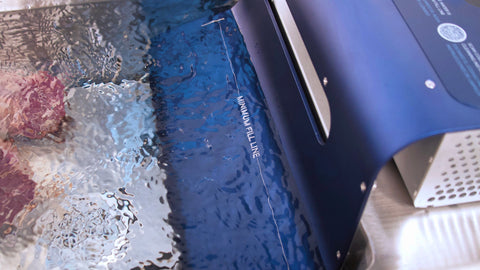
In contrast, purpose-built thawing systems like the CNSRV DC:02 Gen 2 deliver controlled, repeatable thawing without open faucets or ad-hoc workarounds. With an intuitive digital interface and tighter temperature logic, DC:02 aligns thawing outcomes with food-code expectations while dramatically reducing water use compared to running taps.
Beyond water use, faucet thawing creates:
-
Uneven temperatures
-
Partial surface exposure
-
Unpredictable thaw times
-
Increased labor babysitting
What Food Safety Codes Actually Require
Both the FDA Food Code and California Retail Food Code allow thawing under running water — but only when specific conditions are met.
Key requirements include:
-
Water temperature at or below 70°F
-
Continuous water movement
-
Full-surface contact
-
Strict time limits
We break these requirements down in detail in Modernizing Commercial Kitchen Thawing: Why Water, Safety, and Science Matter.
The challenge is that maintaining all of these variables manually — across shifts, staff, and service periods — is harder than most kitchens expect. Systems such as the CNSRV DC:02 Gen 2 are designed from the ground up for compliance with FDA and CA Retail Food Code thawing requirements — maintaining ≤70°F water, ensuring continuous water movement, and controlling time limits through automated logic. By design, DC:02’s digital controls help kitchens match code conditions without heavy manual oversight.
Why Cold Water Thawing Produces Better Food
Cold water thawing isn’t just faster than walk-in defrosting — it’s also better for product quality.
Consistent cold temperatures help protect:
-
Protein structure
-
Moisture retention
-
Texture and yield
This is why cold-water methods consistently outperform ambient or static thawing approaches, as explained in Why Cold Water Thawing Produces the Highest Quality Food.
However, temperature alone isn’t enough.
The Role of Full-Surface Contact and Water Movement
Two of the most misunderstood variables in thawing are surface contact and water movement.
When only part of a protein is exposed to flowing water, thawing becomes uneven and slower than expected. Likewise, stagnant water dramatically reduces heat transfer efficiency.
We explore these mechanics in:
Systems like the CNSRV DC:02 stand apart by engineering optimized fluid dynamics and basket geometry that ensure full surface contact and consistent movement for every item — not just water flowing past part of the protein.
Comparing Commercial Kitchen Thawing Methods
When kitchens compare thawing options, three approaches dominate:
-
Walk-in thawing — slow, space-intensive, and unpredictable
-
Running faucet thawing — variable results and high water waste
-
Purpose-built thawing systems (e.g., CNSRV DC:02 Gen 2) — engineered for predictable outcomes, consistent control, and dramatic water savings
A full side-by-side comparison is available in Cold Water vs Walk-In vs CNSRV: Which Thawing Method Is Actually Best?.
The takeaway is clear: systems designed specifically for thawing outperform improvised methods in speed, safety, and efficiency.
The Hidden Cost of Water Waste
Water waste during thawing is rarely tracked — but it’s significant.
Based on real flow rates and time estimates, kitchens can waste hundreds of thousands of gallons annually during thawing alone. Detailed calculations can be found in:
-
How Much Water Kitchens Waste When Thawing Food (With Real Numbers)
-
Is Your Kitchen Wasting Water? How Much and What It’s Costing You
For multi-unit operators, this waste compounds quickly — and it’s exactly the kind of inefficiency that systems like CNSRV DC:02 Gen 2 are designed to eliminate through controlled, closed-loop water use.
Featured Solution: CNSRV DC:02 Gen 2
The CNSRV DC:02 Gen 2 is a flagship commercial thawing and chilling unit engineered for modern kitchens:
-
Digital temperature controls and intuitive membrane keypad
-
Optimized fluid dynamics for full surface contact
-
Automated safety logic for temperature and flow compliance
-
Robust debris & filtration management
-
Dramatically lower water use vs. running taps
-
Predictable, repeatable results across shifts
This isn’t a workaround — it’s designed for operators who need consistent thawing day in and day out without jeopardizing food safety or efficiency.
Learn more about how DC:02 performs in real kitchens in Cold Water vs Walk-In vs CNSRV: Which Thawing Method Is Actually Best?.
Conclusion
Commercial kitchen thawing no longer has to rely on running faucets, crowded walk-ins, or guesswork.
By understanding what food safety codes actually require — and how water movement, temperature, and surface contact work together — kitchens can adopt thawing methods that are faster, safer, and dramatically more efficient.
Solutions like the CNSRV DC:02 Gen 2 bring this approach into everyday practice, delivering predictable performance, managed water use, and the operational reliability that professional kitchens demand.