Is Your Kitchen Wasting Water? How Much — And What It’s Costing You
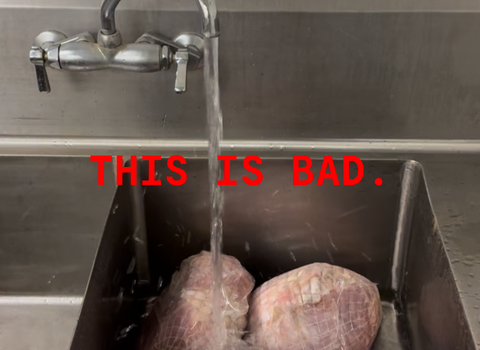
Commercial kitchens waste more water thawing food than almost any other back-of-house activity. The biggest culprit isn’t dishwashing, mop sinks, or ice machines.
It’s defrosting food under a running faucet — a method we break down in detail here:
Why Running-Water Thawing Is Risky
https://cnsrv.com/blogs/news/why-running-water-thawing-is-risky-the-hidden-safety-cost-and-compliance-problems
Across restaurants, hotels, grocery chains, and institutional kitchens, running water remains common simply because it’s familiar. But familiarity comes at a massive cost: water, money, labor, food quality, and safety.
Here’s how much this outdated method is really costing your operation.
How Much Water Does Running-Water Thawing Waste?
Most commercial prep sinks run between 5–10 gallons per minute.
Taking a conservative midpoint — 8 gallons per minute — a typical 45-minute thaw cycle wastes:
8 gallons × 45 minutes = 360 gallons per batch
Many kitchens thaw multiple items per day. As shown in our
Defrosting Time Guide:
https://cnsrv.com/pages/defrost-guide
— thawing is not a short process under a faucet.
Extrapolated annually, a single kitchen easily wastes:
500,000–1,000,000 gallons of potable water per year.
More details and calculations in:
How Much Water Kitchens Waste When Thawing Food
https://cnsrv.com/blogs/news/how-much-water-kitchens-waste-when-thawing-food-with-real-numbers
The Financial Cost: $10,000–$20,000 Per Kitchen, Per Year
Commercial water + sewer rates often fall between $0.02–$0.04 per gallon.
At 500,000–1,000,000 gallons wasted annually, that means:
-
$10,000–$20,000 in unnecessary water costs
-
per location
-
every year
Multi-unit operators feel this most:
-
10 locations → $100K–$200K per year
-
50 locations → $500K–$1M per year
This doesn’t include labor loss, compliance risk, or quality degradation.
Labor Costs You Don’t See — But Definitely Pay For
Running-water thawing also creates hidden operational inefficiencies:
-
Staff must babysit the thawing process
-
Food thaws unevenly, slowing prep
-
Sinks stay blocked for long periods
-
Operators flip or reposition product under the stream
-
Inconsistent thaw times disrupt production schedules
Running water is unpredictable — which is why we compare thawing methods here:
Cold Water vs Walk-In vs CNSRV — Which Is Actually Best?
https://cnsrv.com/blogs/news/cold-water-vs-walk-in-vs-cnsrv-which-thawing-method-is-actually-best
The Bigger Problem: Uneven, Unsafe, Low-Quality Thawing
Beyond waste, running water is simply not effective:
-
Only one small area of the food receives direct water contact
-
Most of the surface sits in warm, stagnant pockets
-
Tap water frequently exceeds 70°F in warmer months
-
Edges thaw too quickly while the center stays frozen
-
Staff compensate with risky shortcuts
These issues are explained in-depth in:
Why Full Surface Contact Is Critical in Safe and Efficient Food Thawing
https://cnsrv.com/blogs/news/why-full-surface-contact-is-critical-in-safe-and-efficient-food-thawing
And in:
Why Continuous Water Movement Matters
https://cnsrv.com/blogs/news/why-continuous-water-movement-matters-in-food-thawing
Poor thawing = poor food.
This is especially true for fish and poultry, as covered in:
How Long Does It Take to Thaw Salmon?
https://cnsrv.com/blogs/news/how-long-does-it-take-to-thaw-salmon-a-complete-guide-for-commercial-kitchens
and
The Safest Way to Thaw Chicken
https://cnsrv.com/blogs/news/the-safest-way-to-thaw-chicken-a-food-safety-expert-guide
A Better Way: Controlled Cold-Water Thawing
Food scientists agree:
Cold-water thawing produces the best food quality and safety outcomes — as shown in:
Why Cold-Water Thawing Produces the Highest-Quality Food
https://cnsrv.com/blogs/news/why-cold-water-thawing-produces-the-highest-quality-food
But cold-water thawing only works when:
-
Food is fully submerged
-
Water actively circulates
-
Temperature stays below 70°F
-
Thaw time is predictable and standardized
That’s exactly what CNSRV was designed for.
See the system here:
CNSRV DC:02
https://cnsrv.com/collections/cnsrv-products/products/cnsrv-dc-02
And the compatible filter system here:
Soft Disposable Filters
https://cnsrv.com/collections/cnsrv-products/products/cnsrv-soft-disposable-filters
The Bottom Line
If your kitchen is thawing under a running faucet, it is:
-
Wasting 500,000–1,000,000 gallons of water per year
-
Losing $10,000–$20,000 annually per location
-
Burning labor and blocking prep sinks
-
Producing unsafe, inconsistent, low-quality results
These losses are completely avoidable.
Modern solutions like CNSRV turn thawing into a controlled, safe, efficient, predictable process — reducing water use by up to 98% and dramatically improving kitchen operations.
To learn more about how CNSRV works across foodservice environments, see:
https://cnsrv.com/blogs/news/cnsrv-featured-in-food-and-wine