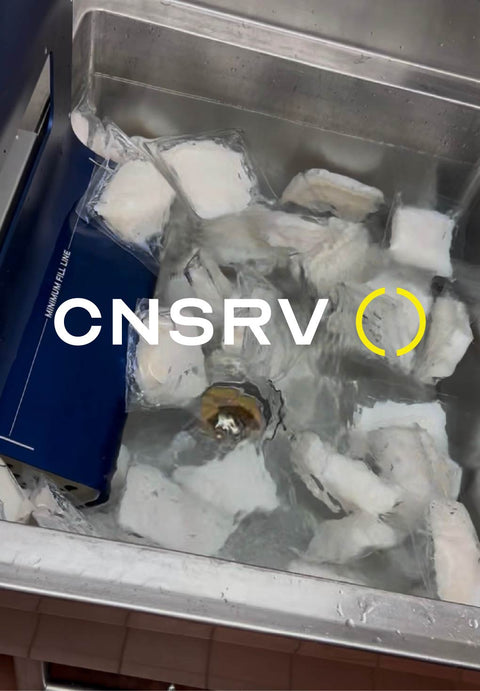
Why Full Surface Contact Is Critical in Safe and Efficient Food Thawing
Full surface contact is one of the most important — yet least understood — factors in safe and consistent food thawing. While most operators focus on time or water temperature, the actual key to predictable, uniform, and code-aligned thawing is ensuring that the entire surface of the food experiences the same conditions throughout the process.
This article explains why full surface contact matters, the science behind it, and how it directly affects thawing speed, food safety, product quality, and overall kitchen efficiency.
1. Uneven Thawing Begins With Uneven Contact
The biggest flaw in traditional thawing methods (running faucets, walk-ins, tubs of static water) isn’t just inefficiency — it’s uneven exposure.
With walk-ins:
-
Only the exposed outer surface warms
-
The center stays frozen for hours
-
Temperature differentials grow large
-
Timing becomes unpredictable
With running-water thawing:
-
Only the splashed surface gets thawed
-
Top and side sections sit above the waterline
-
Air exposure creates warm spots
-
Operators must constantly reposition the product
This uneven contact is the root of:
-
Safety risks
-
Slow thawing
-
Inconsistent results
-
Labor inefficiency
For a deeper comparison, see:
👉 Cold Water vs Walk-In vs CNSRV
2. Full Surface Contact Maximizes Heat Transfer Efficiency
Heat transfer depends on how consistently the thawing medium (water or air) reaches the food’s surface. Water transfers heat 25 times faster than air — but this advantage disappears when water fails to reach all sides of the product.
With full-surface contact:
-
Every square inch of the food is exposed to the same temperature
-
Heat transfer is evenly distributed
-
No “partially thawed / partially frozen” zones develop
-
Thawing speed increases significantly
Without full contact, the thawing process becomes fragmented and slow.
For a breakdown of running-water limitations, see:
👉 Why Running-Water Thawing Is Risky
3. Incomplete Contact Leads to Warm Pockets and Safety Hazards
When sections of the product are:
-
above the waterline,
-
exposed to warm kitchen air, or
-
pressed against parts of the container,
temperature inconsistencies form.
These areas:
-
warm faster than submerged zones
-
may exceed safe limits (above 41°F or 70°F depending on method)
-
allow bacterial growth while the interior is still frozen
-
easily violate the 2-hour regulatory limit
Full surface contact prevents warm pockets entirely by ensuring the entire product remains in a controlled, uniform environment.
For food code requirements, see:
👉 Understanding FDA & California Thawing Requirements
4. Full Surface Contact Reduces Overall Thaw Time
Thawing speed improves dramatically when the entire surface receives equal exposure to temperature-controlled water.
When only a portion of the product is thawing:
-
heat transfer is bottlenecked
-
thawing slows down
-
operators must intervene
-
food stays at unsafe temperatures longer
But when the entire surface area participates in heat transfer:
-
thawing becomes faster
-
cycles become predictable
-
timing becomes standardized across locations
This is why systems that support full immersion consistently outperform running water, tubs, or walk-in thawing.
To learn how movement enhances this effect, see:
👉 Why Continuous Water Movement Matters in Food Thawing
5. Full Surface Contact Improves Product Quality and Yield
Uneven thawing impacts texture, color, and cook results.
When one side warms faster than the other:
-
proteins denature unevenly
-
moisture drains from outer layers
-
cooked texture becomes inconsistent
-
edges may become mushy while the interior remains firm
Full-surface contact:
-
preserves moisture
-
maintains structural integrity
-
reduces drip loss
-
provides better sear, flake, and mouthfeel after cooking
This is especially important for:
-
salmon and seafood
-
poultry
-
large proteins (turkey, beef, pork)
-
vacuum-sealed products
For additional examples, see:
👉 How Long Does It Take to Thaw Salmon?
6. Why CNSRV Prioritizes Full Surface Contact
The CNSRV system is engineered to ensure that food:
-
is fully submerged
-
maintains constant surface contact with temperature-controlled water
-
receives even exposure regardless of size or packaging
By combining full immersion with continuous movement and temperature regulation, CNSRV achieves:
-
the most uniform thawing method available
-
the fastest safe thawing speeds
-
consistent results across all kitchens
-
strict alignment with FDA and state code
-
98% reduction in water usage
Explore the technology here:
👉 CNSRV DC:02
7. Full Surface Contact + Continuous Movement = The Optimal Thawing Method
On their own:
-
Full surface contact improves uniformity
-
Continuous water movement improves heat transfer
Together:
-
They eliminate warm pockets
-
They keep temperatures stable
-
They maximize heat transfer speed
-
They significantly outperform traditional methods
This pairing creates the industry’s most advanced, safest, and most efficient thawing environment.
Bottom Line
Full surface contact is not a detail — it is the foundation of safe, efficient, and high-quality thawing.
It ensures:
-
Even heat transfer
-
Rapid thawing
-
Consistent product quality
-
Compliance with food safety regulations
-
Reduced labor oversight
-
Major water savings
Modern systems like CNSRV are designed to guarantee full contact and full control during every thawing cycle.