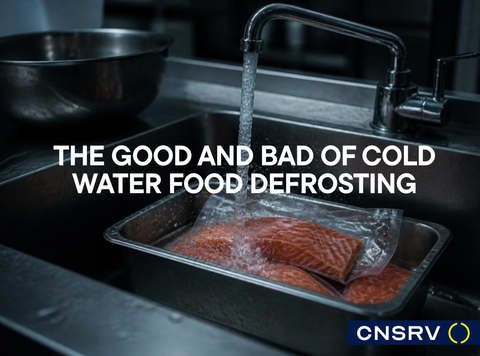
The Good and Bad of Cold Water Food Defrosting: Pros and Cons for Commercial Kitchens
Cold water defrosting is the fastest safe way to thaw frozen food, and the research says it protects quality better than a slow thaw in the walk-in. It is also the method most commercial kitchens get wrong. The problem is not the cold water. It is the running faucet most kitchens use to deliver it.
This guide lays out the real pros and cons of cold water defrosting, where each con actually comes from, and how to keep the good while removing the bad.
Key takeaways
- The good: cold water thaws food far faster than refrigeration, with less drip loss and better texture and color.
- The bad: done under a running faucet, it wastes hundreds of gallons per cycle, thaws unevenly, can damage delicate product, and drifts out of compliance when tap water runs warm.
- The fix: every one of the cons comes from the faucet, not from cold water itself. A controlled, recirculating system keeps the benefits and removes the drawbacks.
What is cold water defrosting?
Cold water defrosting means thawing frozen food while it is fully submerged in cold, moving water. It is one of the thawing methods approved under FDA Food Code Section 3-501.13, which requires the water to be 70°F or below and moving with enough velocity to agitate the product and float off loose particles.
In most commercial kitchens, that means a prep sink, a container of frozen product, and a faucet left running until the food is thawed.
What are the pros of cold water defrosting?
It is fast
Water transfers heat far more efficiently than air. A case of protein that needs a day or more in the walk-in can be ready in hours, or minutes for thinner cuts. That speed is what lets a kitchen thaw to demand instead of guessing at tomorrow's covers two days ahead.
It protects quality
Research from the SP Technical Research Institute of Sweden found that faster thawing in water reduces the quality loss that comes with a slow thaw. Food spends less time in the temperature range where drip loss, texture breakdown, and color change happen. We cover the science in detail in Why Cold-Water Thawing Produces the Highest-Quality Food.
It is flexible
Cold water thawing happens at the prep sink, on the day you need the product. It does not tie up walk-in shelf space for days, and it gives you a recovery option when a delivery arrives frozen solid or a large order comes in late.
It is code compliant when done correctly
Health inspectors recognize cold water thawing as an approved method, provided the water temperature, water movement, and time limits are all met.
What are the cons of cold water defrosting?
Here is the part most guides skip. Each of these problems is real, and each one traces back to the running faucet.
It uses a staggering amount of water
A commercial prep faucet delivers roughly 4 to 8 gallons per minute. At 5 gallons per minute, a single one-hour thaw sends 300 gallons down the drain. Longer cycles on dense product can run past 900 gallons. Multiply that by daily prep and the faucet becomes one of the largest water users in the kitchen. See the full math in How Much Water Do Commercial Kitchens Waste Thawing Food?
It thaws unevenly
A faucet delivers water in one concentrated stream. The product directly under the stream gets constant, forceful flow. The product at the edges and bottom of the container sits in slow or stagnant water. The result is a batch where some pieces are fully thawed and others still have frozen centers.
It can damage delicate product
Shrimp, salmon, and other delicate proteins show the damage most clearly. Product that sits under a direct stream comes out discolored and visibly worn compared with product thawed in evenly moving water. That is yield and plate appearance lost before the food reaches the line. For salmon specifically, see How Long Does It Take to Thaw Salmon?
Water temperature is out of your control
The code limit is 70°F. Tap water in many regions runs 75 to 85°F in summer. A faucet has no way to correct that, which means a kitchen can be out of compliance the moment the water is turned on, with nobody aware of it.
It depends on someone watching it
Faucet thawing has no timer, no temperature check, and no shutoff. Staff get pulled to other tasks, product sits past the time limit, and the sink is tied up for the whole cycle. It works when someone is paying attention, and prep hours are when attention is hardest to spare.
For a deeper look at the safety and compliance side, read Why Running-Water Thawing Is Risky.
Cold water defrosting pros and cons at a glance
| Factor | Running faucet | Controlled cold water (CNSRV DC:02) |
|---|---|---|
| Speed | Faster than the walk-in | Less than half the faucet time |
| Water use | 4 to 8 gallons per minute, down the drain | 98% less water than a running faucet |
| Evenness | One stream, stagnant zones | Full surface contact, continuous circulation |
| Product quality | Risk of discoloration and damage | Product keeps its original color and texture |
| Water temperature | Whatever the tap delivers | Automatic shutoff at 66°F |
| Labor | Needs monitoring | Runs on its own |
How do you keep the pros and remove the cons?
The CNSRV DC:02 was built around one idea: cold water is the right way to thaw, and the faucet is the wrong way to deliver it. The unit drops into a standard prep sink with no installation and no plumbing changes, then recirculates the same water instead of sending it down the drain.
- 98% less water than a running faucet.
- Circulation of about 130 gallons per minute, so every piece of product gets the same moving water, with no stream damage and no stagnant corners.
- Automatic shutoff at 66°F, safely under the 70°F limit.
- NSF51 certified, and independently reviewed by Dr. Eric Schulze, PhD, a former FDA food-safety regulator. Details are on our health and safety page.
How much faster is it?
| Product | Running faucet | CNSRV DC:02 |
|---|---|---|
| Salmon | 35 to 55 minutes | 15 to 25 minutes |
| Chicken breasts | 40 to 75 minutes | 15 to 30 minutes |
| Ground beef | 60 to 120 minutes | 25 to 45 minutes |
Times for more products are in the CNSRV Defrost Time Guide.
Real kitchen example
Nobu Malibu saved more than $2,000 on its water bill in the first month after replacing faucet thawing with the DC:02. More results are in The CNSRV DC:02 in Commercial Kitchens: Real Results from Real Operations.
Frequently asked questions
Is cold water defrosting safe?
Yes, when the water stays at 70°F or below, keeps moving, and the food does not sit above 41°F longer than the code allows. The risk comes from warm tap water and unmonitored cycles, not from the method itself.
Is cold water defrosting better than thawing in the refrigerator?
For quality and speed, yes. Refrigerator thawing is safe but slow, and the long thaw time increases drip loss. See our comparison: Cold Water vs Walk-In vs CNSRV.
How much water does defrosting under a faucet use?
A faucet running at 5 gallons per minute uses 300 gallons an hour. A four-hour cycle on large product can use 960 to 1,920 gallons, depending on flow rate.
Why does faucet-thawed fish look discolored?
The concentrated stream hits the same spot on the product for the entire cycle. On delicate proteins like salmon and shrimp, that constant force damages the surface and washes out color.
Can I defrost in still cold water instead?
Not in a commercial kitchen. The FDA Food Code requires the water to be moving. Still water also warms up around the product and thaws slowly and unevenly.
The bottom line
Cold water defrosting is the right method. The running faucet is the wrong tool. The speed and quality benefits belong to cold water. The waste, uneven results, product damage, and compliance risk belong to the faucet. Replace the faucet with controlled circulation and you keep everything good about cold water thawing.
Use the CNSRV savings calculator to see what faucet thawing costs your kitchen each year, check the rebates available in your area, or book a demo to see the DC:02 in action.